
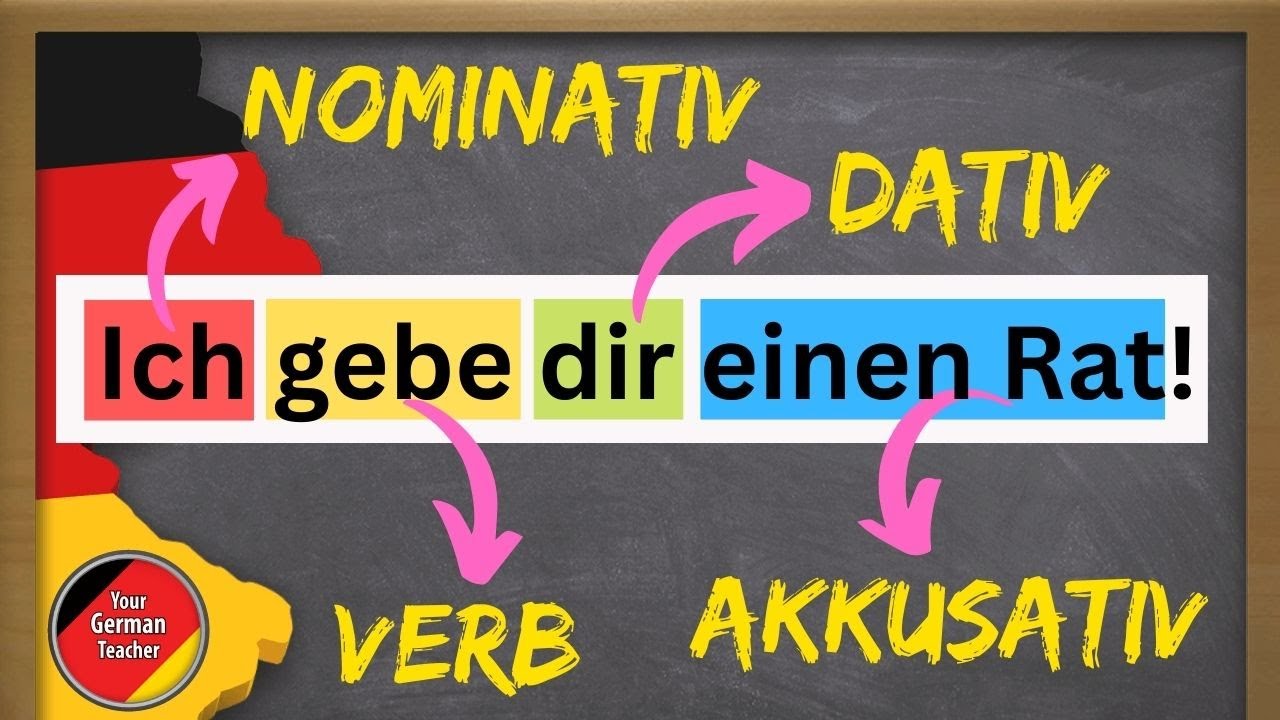
How to use Nominativ, Akkusativ & Dativ | Text Analysis
The best way to understand German cases is to take a real text apart sentence by sentence. In this lesson Luzi analyzes a diary entry he wrote, called “Ein Tag aus Luzis Leben”. For every sentence he finds the subject, the verb and the objects and explains why each one is Nominativ, Akkusativ or Dativ. The text is A1 level, but you can do the same exercise with any text, at A2, B1 or higher.
The Method: Four Colours
| Colour | What it marks | Rule |
|---|---|---|
| Red | Nominativ: the subject | The Nominativ is only for the subject. Words like ich, du, er and wir are Nominativ pronouns, so they are always the subject. |
| Yellow (gold) | The verb | In a diary you use the Perfekt: a helping verb (haben or sein) and a Partizip. |
| Blue | Akkusativ | The direct object, and everything after a preposition that takes the Akkusativ (für, um, bis, über). |
| Green | Dativ | Everything after a preposition that takes the Dativ (mit, nach, zu, in for a place), and the person when a verb like geben has two objects. |
For every sentence Luzi asks the same questions in the same order: Who is the subject? What is the verb? Is there a noun that is not the subject? Then it is an object, and the verb or a preposition tells you the case. Always look at the preposition first, because the preposition gives you the case.
Paragraph 1: Morning with the Dog
| Sentence | Subject (Nominativ) | Verb | Objects and prepositions |
|---|---|---|---|
| 1. Gestern bin ich um 7 Uhr aufgestanden. | ich | bin aufgestanden (Perfekt with sein) | um 7 Uhr: Akkusativ (um) |
| 2. Zuerst habe ich einen Kaffee getrunken und ein Käsebrot gegessen. | ich (not repeated after und) | habe getrunken, (habe) gegessen | einen Kaffee, ein Käsebrot: Akkusativ (trinken, essen) |
| 3. Dann war ich mit meinem Hund im Park. | ich | war (Präteritum of sein) | mit meinem Hund: Dativ (mit); im Park (in dem): Dativ |
| 4. Das Wetter war schön und die Temperaturen nicht zu hoch. | das Wetter / die Temperaturen | war | no object; schön and hoch are adjectives |
| 5. Wir sind für eine Stunde gelaufen. | wir | sind gelaufen | für eine Stunde: Akkusativ (für) |
| 6. Dann war mein Hund müde und wir sind nach Hause gegangen. | mein Hund / wir | war, sind gegangen | nach Hause: Dativ (nach, fixed expression) |
| 7. Er ist schon ein bisschen alt. | er | ist (present, the dog is still alive) | no object; alt is an adjective |
| 8. Zu Hause habe ich ihm sein Frühstück gegeben. | ich | habe gegeben | ihm: Dativ (the person); sein Frühstück: Akkusativ (the thing); zu Hause: zu + Dativ, fixed expression |
Paragraph 2: Work Day
| Sentence | Subject (Nominativ) | Verb | Objects and prepositions |
|---|---|---|---|
| 9. Um 10 Uhr hatte ich ein Online-Meeting mit meinem Chef. | ich | hatte (Präteritum of haben) | ein Online-Meeting: Akkusativ (haben); um 10 Uhr: Akkusativ; mit meinem Chef: Dativ |
| 10. Zurzeit mache ich Home Office. | ich | mache | Home Office: Akkusativ (machen) |
| 11. Das Meeting war nicht lang. | das Meeting | war | no object; lang is an adjective |
| 12. Wir haben über ein Projekt gesprochen. | wir | haben gesprochen | über ein Projekt: Akkusativ (sprechen über + Akkusativ) |
| 13. Am Mittag habe ich einen Salat gegessen und dann ein bisschen mit meinem Hund gespielt. | ich (not repeated) | habe gegessen, (habe) gespielt | einen Salat: Akkusativ; am Mittag (an dem): Dativ; mit meinem Hund: Dativ |
| 14. Am Nachmittag habe ich bis 17.30 Uhr gearbeitet. | ich | habe gearbeitet | am Nachmittag: Dativ; bis 17.30 Uhr: Akkusativ (bis) |
| 15. Um 15 Uhr habe ich eine Pause gemacht und ein Sandwich gegessen. | ich | habe gemacht, (habe) gegessen | eine Pause, ein Sandwich: Akkusativ; um 15 Uhr: Akkusativ |
Paragraph 3: Evening
| Sentence | Subject (Nominativ) | Verb | Objects and prepositions |
|---|---|---|---|
| 16. Nach der Arbeit habe ich eingekauft. | ich | habe eingekauft (einkaufen = buy groceries) | nach der Arbeit: Dativ (nach) |
| 17. Ich habe Brot, Nudeln, Tomaten und ein Stück Fleisch gekauft. | ich | habe gekauft | everything bought: Akkusativ (kaufen); this und only ends a list |
| 18. Um 19.30 Uhr habe ich mein Abendessen gekocht. | ich | habe gekocht | mein Abendessen: Akkusativ (kochen); um 19.30 Uhr: Akkusativ |
| 19. Meine Freundin hat mit ihren Kolleginnen in einem Restaurant gegessen. | meine Freundin | hat gegessen | mit ihren Kolleginnen: Dativ (mit); in einem Restaurant: Dativ (in, place) |
| 20. Sie ist um 21 Uhr nach Hause gekommen. | sie (= meine Freundin) | ist gekommen | um 21 Uhr: Akkusativ; nach Hause: Dativ (fixed expression) |
| 21. Wir haben zusammen einen Film geschaut. | wir | haben geschaut | einen Film: Akkusativ (schauen) |
| 22. Nach dem Film haben wir das Geschirr abgewaschen. | wir | haben abgewaschen (abwaschen is separable) | das Geschirr: Akkusativ; nach dem Film: Dativ |
| 23. Und dann um 23 Uhr sind wir schlafen gegangen. | wir | sind gegangen | um 23 Uhr: Akkusativ |
Points to Remember from the Analysis
- After und you can drop the subject and the helping verb if they are the same: Ich habe einen Kaffee getrunken und ein Käsebrot gegessen. The subject is still ich.
- Nouns that are not the subject are objects. Most verbs take an Akkusativ object, for example trinken, essen, haben, machen, kaufen, kochen, schauen and abwaschen.
- Time with um and bis is Akkusativ, but you do not see it because there is no article: um 10 Uhr, bis 17.30 Uhr.
- Am and im are Dativ. Am Mittag is an dem Mittag and im Park is in dem Park.
- Nach Hause and zu Hause are fixed expressions with a Dativ preposition. Learn them as they are.
- Geben can have two objects. The person is Dativ and the thing is Akkusativ: Ich habe ihm sein Frühstück gegeben.
- A und between two nouns in a list is not a new sentence: Brot, Nudeln, Tomaten und ein Stück Fleisch are all Akkusativ.
Three Bonus Tips from Luzi
- Write your own diary. You do not have to write every day, two or three times a week is enough.
- Analyze your own text like in this lesson: find the subject, the verb, the objects and the cases. Then explain your analysis to someone else, for example a classmate (or your mom or your dog). Explaining it helps you a lot.
- Read your text out loud. This also helps your speaking.
What to Learn Next
If you want to know all prepositions for A1, watch all German A1 prepositions. To go deeper into each case, see what is the Nominativ, what is the Akkusativ and what is the Dativ. For prepositions that can take either case, read German two-way prepositions, and for the order of the parts of a sentence, Satzbau IV: TEKAMOLO.
Frequently Asked Questions
How do I find out if a word is Nominativ, Akkusativ or Dativ?
First find the subject (Nominativ). If there is a preposition, it tells you the case. If there is no preposition, the verb decides: most verbs take an Akkusativ object, and a verb like geben adds a Dativ for the person.
Why is “um 10 Uhr” in the Akkusativ?
The preposition um always takes the Akkusativ. You do not see it in expressions of time like um 10 Uhr or bis 17.30 Uhr because there is no article.
Why do mit, nach and zu always need the Dativ?
They are Dativ prepositions, so everything after them is in the Dativ: mit meinem Hund, nach der Arbeit, zu Hause. The fixed expressions nach Hause and zu Hause follow the same rule.
Can a sentence have an Akkusativ and a Dativ object at the same time?
Yes. With verbs like geben the person is in the Dativ and the thing is in the Akkusativ: Ich habe ihm sein Frühstück gegeben.
How can a diary help me learn German grammar?
Write a short diary two or three times a week, analyze it like in this lesson (subject, verb, objects, cases), explain the analysis to someone and read the text out loud.
Want to practise cases and prepositions step by step with exercises? Our A1 German online course is built for exactly that.
