
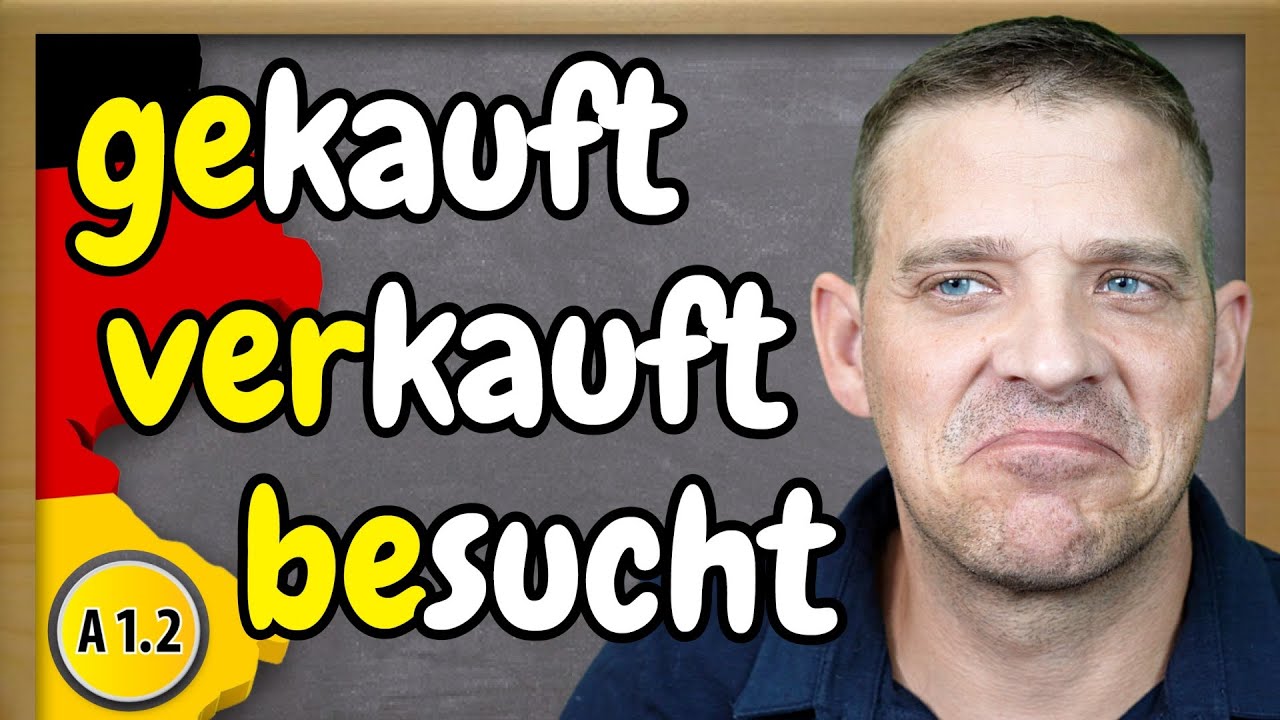
The German Past Participle - Exceptions
Most German past participles start with ge- — but a large and completely predictable group of verbs never gets a ge- at all. The good news: it's not random. Two clear rules tell you exactly when to leave it off.
The Regular Pattern (For Comparison)
Normally, a past participle is built as ge- + stem + -t (weak/regular verbs) or ge- + stem (often vowel-changed) + -en (strong/irregular verbs):
- machen → gemacht
- spielen → gespielt
- sehen → gesehen
The two exceptions below both remove the ge-, and they're each triggered by a specific, learnable signal in the verb itself.
Rule 1: Inseparable Prefixes Never Take "ge-"
German has a fixed set of unstressed prefixes that are always inseparable from the verb — they never split off, and they block ge- entirely: be-, ge-, er-, ver-, zer-, ent-, emp-, miss-.
- besuchen → besucht (not gebesucht) — visited
- verstehen → verstanden — understood
- erklären → erklärt — explained
- bezahlen → bezahlt — paid
- entschuldigen → entschuldigt — excused/apologized
- zerstören → zerstört — destroyed
You can recognize these prefixes because the word stress falls on the verb stem, not on the prefix itself — say beSUCHen, not BEsuchen. That stress pattern is the reliable signal that ge- won't appear.
Rule 2: Verbs Ending in "-ieren" Never Take "ge-"
Verbs borrowed from other languages (mostly French or Latin roots) that end in -ieren also skip the ge-, and simply add -t at the end, with no vowel change:
- studieren → studiert — studied
- telefonieren → telefoniert — telephoned
- fotografieren → fotografiert — photographed
- reparieren → repariert — repaired
- diskutieren → diskutiert — discussed
This is an easy rule to spot and apply, since -ieren verbs are common at every level and always behave the same way.
Bonus Tip: Separable Verbs Still Get "ge-" — Just in the Middle
Don't confuse inseparable prefixes with separable ones (like ein-, auf-, an-, mit-, aus-). Separable-prefix verbs absolutely do get a ge-, it just gets inserted between the prefix and the stem instead of at the very front:
- einkaufen → eingekauft (not geeinkauft) — shopped
- aufstehen → aufgestanden — got up
- anrufen → angerufen — called
So the full picture is: inseparable prefixes and -ieren verbs block ge- entirely; separable prefixes keep ge-, just tucked inside the word.
Quick Test: Does This Verb Need a "ge-"?
- Does it start with be-, ge-, er-, ver-, zer-, ent-, emp-, or miss-? → No ge-.
- Does it end in -ieren? → No ge-, just add -t.
- Otherwise (including separable-prefix verbs) → normal ge- rule applies (at the front, or inserted after a separable prefix).
Frequently Asked Questions
Which German verbs don't take "ge-" in the past participle?
Two groups: verbs with an inseparable prefix (be-, ge-, er-, ver-, zer-, ent-, emp-, miss-), and verbs ending in -ieren. Both simply skip the ge- and, for -ieren verbs, just add -t at the end.
How can I tell if a prefix is inseparable?
Inseparable prefixes are unstressed — the word stress falls on the verb stem, not the prefix (beSUCHen, not BEsuchen). The fixed set to memorize is be-, ge-, er-, ver-, zer-, ent-, emp-, and miss-.
Do separable verbs like "aufstehen" still use "ge-"?
Yes — separable-prefix verbs still take a ge-, but it's inserted between the prefix and the stem rather than at the very beginning: aufstehen becomes aufgestanden, not geaufgestanden or aufgesteht.
Why don't "-ieren" verbs take "ge-"?
These verbs are borrowed from other languages (often French or Latin) and follow their own fixed pattern: no ge-, just add -t to the stem, as in studiert, telefoniert, and fotografiert.
What's the past participle of "verstehen"?
Verstanden — no ge- prefix, because ver- is one of the fixed inseparable prefixes that always blocks it.
The Perfekt tense (and a lot more) is covered in full inside our A1 German lessons.
