
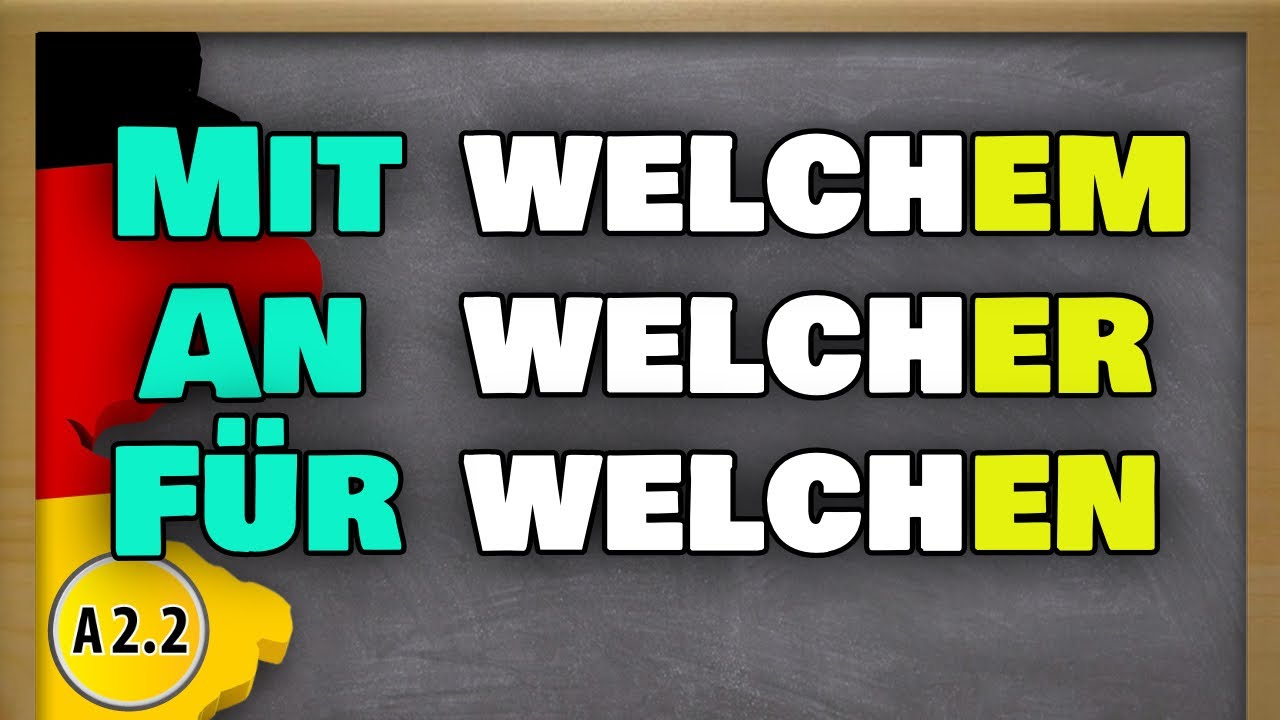
German questions with Prepositions & "welch-"
"Welcher" behaves exactly like the definite article "der" — which is great news, because it means you already know most of what you need to use it correctly with prepositions. This lesson shows how "welch-" changes its ending (welchem, welcher, welchen, and so on) depending on the case a preposition requires and the gender of the noun that follows, with example questions for dative, accusative, and two-way prepositions.
"Welch-" Follows the Same Pattern as "Der"
Just like the definite article, "welch-" takes different endings depending on case and gender: welcher (masculine nominative), welchem (masculine/neuter dative), welchen (masculine accusative/all plural dative), and so on. If you already know how "der, die, das" change across the cases, you can predict almost every "welch-" ending the same way.
"Welch-" With Dative Prepositions
Prepositions like mit, bei, nach, von, zu always require the dative case, so "welch-" takes a dative ending after them: Mit welchem Bus fährst du? — Which bus are you taking? Bei welcher Firma arbeitest du? — Which company do you work at?
"Welch-" With Accusative Prepositions
Prepositions like für, durch, gegen, ohne, um always require the accusative case: Für welchen Kurs hast du dich entschieden? — Which course did you decide on? Durch welche Stadt fahren wir? — Which city are we driving through?
"Welch-" With Two-Way Prepositions
With Wechselpräpositionen like in, an, auf, the ending on "welch-" depends on whether the question is about movement (accusative) or location (dative): In welche Stadt fährst du? — Which city are you going to? (movement, accusative) vs. In welcher Stadt wohnst du? — Which city do you live in? (location, dative).
Frequently Asked Questions
How does "welch-" change with different prepositions?
"Welch-" takes the ending required by the case that each preposition governs — dative endings after dative prepositions (mit, bei, nach, von, zu), accusative endings after accusative prepositions (für, durch, gegen, ohne, um), and either depending on context after two-way prepositions.
Does "welch-" follow the same pattern as "der, die, das"?
Yes — "welch-" changes its ending across cases and genders following essentially the same pattern as the definite article, which makes its forms predictable once you know the der/die/das declension.
What is the difference between "welchem" and "welchen"?
"Welchem" is used for masculine and neuter nouns in the dative case, while "welchen" is used for masculine nouns in the accusative case and for all genders in the plural dative.
How do you decide which case to use with a two-way preposition and "welch-"?
Ask whether the question describes movement toward something (accusative, e.g. "In welche Stadt fährst du?") or a fixed location (dative, e.g. "In welcher Stadt wohnst du?").
Which prepositions always take the dative case with "welch-"?
Mit, bei, nach, von, and zu always take the dative case, so "welch-" always takes a dative ending after them.
Question formation like this gets plenty of hands-on practice in our A2 German course.
