
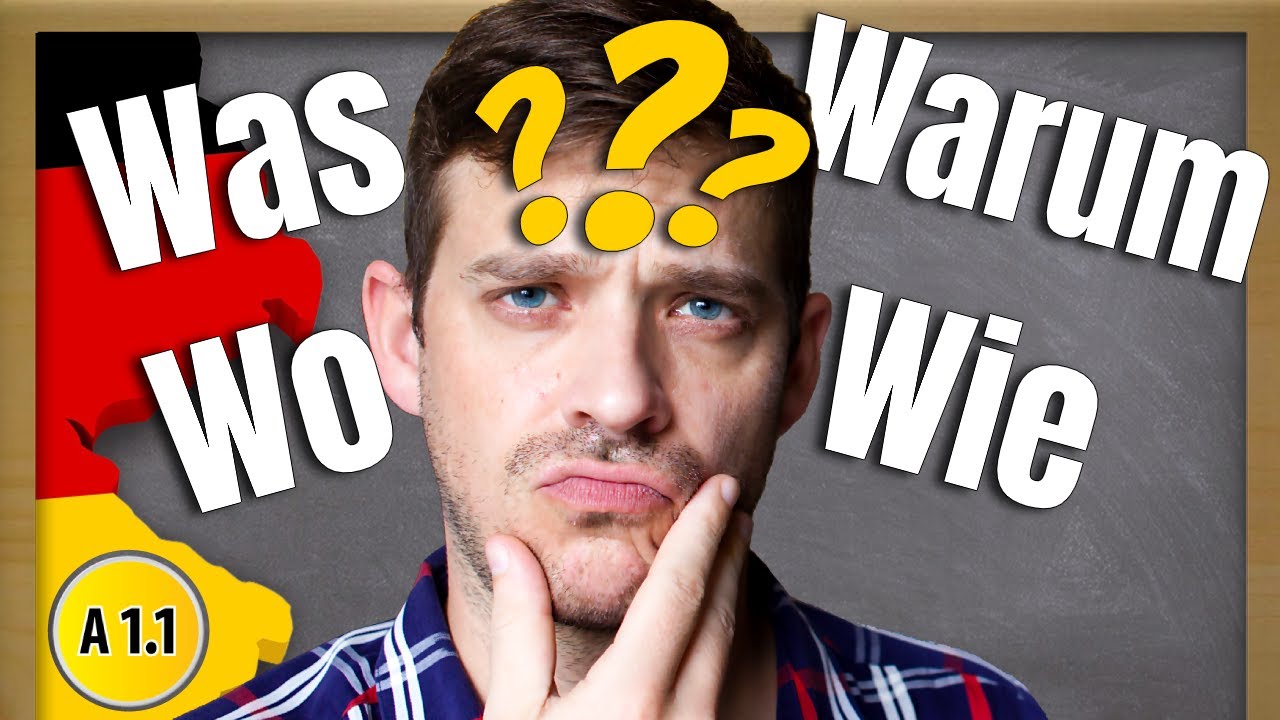
Basic German Question Words Explained
If you can ask questions in German, you can start real conversations from day one. In this lesson Luzi explains the 12 most important German question words, called Fragewörter, with several example questions for each one. At the end there is a bonus tip about the question word welch-.
The 12 Most Important German Question Words
| Question word | Meaning |
|---|---|
| wer | who |
| wie | how |
| was | what |
| wo | where |
| woher | where from |
| wohin | where to |
| wann | when |
| was für | what kind of |
| warum | why |
| wie oft | how often |
| wie viel | how much (things you cannot count) |
| wie viele | how many (things you can count) |
wer (who)
- Wer ist das? (Who is that?)
- Wer isst gern Äpfel? (Who likes to eat apples?)
- Wer wird Millionär? (Who becomes a millionaire? (the name of a famous TV quiz show))
wie (how)
- Wie geht's? (How are you?)
- Wie heißt du? (What is your name?)
- Entschuldigung, wie komme ich zum Bahnhof? (Excuse me, how do I get to the train station?)
was (what)
- Was ist das? (What is this?)
- Was isst du gern? (What do you like to eat?)
- Was heißt “table” auf Deutsch? (What does “table” mean in German?)
The last question is very useful: every time you do not know a word, ask Was heißt ... auf Deutsch?
wo, woher and wohin
These three belong together: wo asks about a place, woher asks where something comes from, wohin asks where something is going.
- Wo wohnst du? (Where do you live?)
- Wo sind sie? (Where are they?)
- Wo machst du oft Urlaub? (Where do you often go on vacation?)
- Woher kommst du? (Where are you from?)
- Woher kommt dein Freund? (Where is your friend from?)
- Wohin gehst du? (Where are you going?)
- Wohin fahren wir? (Where are we driving to?)
With woher and wohin you can split the word: wo stays at the beginning and her or hin moves to the end. Both versions are fine, and the split version is very common in spoken German.
- Wo kommst du gerade her? (Where did you just come from? (the same as Woher kommst du gerade?))
- Wo geht sie hin? (Where is she going? (the same as Wohin geht sie?))
wann (when)
- Wann gehst du? (When are you leaving?)
- Wann gehen wir nach Hause? (When are we going home?)
- Wann kommt der Zug? (When does the train come?)
was für (what kind of)
Was für is a combination of was and für. It is a very useful question word.
- Was für ein Handy hast du? (What kind of phone do you have?)
- Was für Bücher lest ihr gern? (What kind of books do you like to read?)
- Was für ein Auto fährst du? (What kind of car do you drive?)
warum (why)
- Warum lernst du Deutsch? (Why do you learn German?)
- Warum ist der Himmel blau? (Why is the sky blue?)
- Warum hat man Schluckauf? (Why do people get hiccups?)
The word man in the last sentence does not mean “you” personally. It stands for people in general.
wie oft (how often)
- Wie oft lernst du Deutsch? (How often do you learn German? (Be honest!))
- Wie oft soll man die Haare waschen? (How often should you wash your hair?)
- Wie oft geht ihr ins Kino? (How often do you go to the cinema?)
wie viel and wie viele (how much and how many)
Use wie viel for things you cannot count and wie viele for things you can count.
- Wie viel kostet eine Cola? (How much does a cola cost?)
- Wie viel Geld brauchst du? (How much money do you need?)
- Wie viel Wasser trinkst du pro Tag? (How much water do you drink per day?)
- Wie viele Einwohner hat Deutschland? (How many inhabitants does Germany have?)
- Wie viele Zähne hat ein Mensch? (How many teeth does a human have?)
- Wie viele Stunden hat ein Jahr? (How many hours does a year have?)
Important: after wie viele the noun is always in the plural: ein Zahn, zwei Zähne, so you ask Wie viele Zähne ...?, and eine Stunde, zwei Stunden, so you ask Wie viele Stunden ...?
Bonus Tip: welcher, welche, welches (which)
In English it is always “which”, but in German welch- changes its ending to match the gender of the noun that follows.
| Gender | Question word | Example |
|---|---|---|
| masculine | welcher | Welcher Tag ist heute? (Which day is today?) Der Tag is masculine. |
| feminine | welche | Welche Mütze soll ich heute tragen? (Which cap should I wear today?) Die Mütze is feminine. |
| neuter | welches | Welches Bild gefällt dir? (Which picture do you like?) Das Bild is neuter. |
| plural | welche | Welche Mützen ...? (Which caps ...?) The plural is the same as the feminine. |
Your Turn: Question of the Day
This time you ask the question. Write a question that starts with one of the question words above, for example Wo ...?, Woher ...?, Warum ...?, Wohin ...?, Wie ...? or Was für ...?, and share it in the YouTube comments.
What to Learn Next
To go deeper into the bonus tip, watch welcher, welche, welches: which one to use. For the question words for people and cases, see wer, wen, wem. Use your questions in how to introduce yourself in German, and learn how questions can sit inside other sentences in German indirect questions.
Frequently Asked Questions
What are the basic German question words?
The 12 most important ones are wer (who), wie (how), was (what), wo (where), woher (where from), wohin (where to), wann (when), was für (what kind of), warum (why), wie oft (how often), wie viel (how much) and wie viele (how many).
What is the difference between wo, woher and wohin?
Wo asks about a place (Wo wohnst du?), woher asks where someone or something comes from (Woher kommst du?), and wohin asks about the direction (Wohin gehst du?).
What is the difference between wie viel and wie viele?
Use wie viel for things you cannot count, such as money or water (Wie viel Geld brauchst du?). Use wie viele for countable things, and put the noun in the plural (Wie viele Zähne hat ein Mensch?).
How do you ask “What does ... mean in German?”
Ask Was heißt ... auf Deutsch?, for example Was heißt “table” auf Deutsch? This is the best question to ask whenever you do not know a word.
Why does welcher change to welche or welches?
Because welch- takes the gender of the noun after it: welcher Tag (masculine), welche Mütze (feminine and plural), welches Bild (neuter).
Asking questions is a skill that grows with practice. Our German A1 course online includes speaking and listening practice for exactly these everyday questions, plus worksheets and a place to ask us your own.
