
German Indefinite Pronouns: The Ultimate Guide | B2
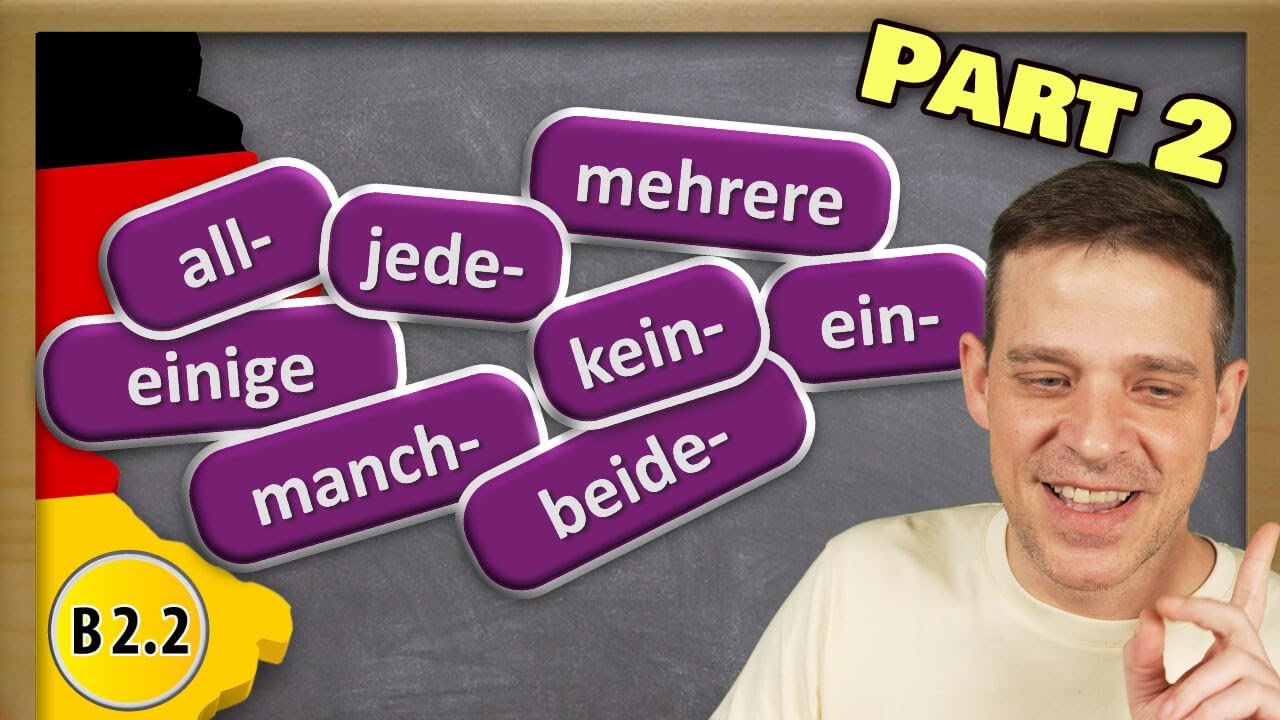
Part 2 of the indefinite pronouns covers the eight that can be used for both people and things: alle, jeder, einige, manche, mehrere, ein, kein and beide. This is a long and detailed B2 lesson with many special rules, so you should be at B2 or at least late B1 level. If you have not seen part 1 about man, jemand, niemand, alles, etwas, nichts and welch-, start there.
Three Features They Share
- They can be used for people and things.
- They are declined: the ending changes with case, number and gender, mostly like the definite article.
- Most of them can also be used as an article.
Pronoun or Article?
A pronoun replaces a noun, so no noun follows: Alle sind bereit. An article stands in front of a noun: Alle Leute sind bereit. The declension is almost always the same. The only question is whether a noun follows.
alle: all, everybody, everything
Alle refers to the entire group.
| Use | Forms | Examples |
|---|---|---|
| Pronoun for people, plural only | alle (Nom./Akk.), allen (Dat.) | Alle wollen den neuen Film sehen. Everyone wants to see the new movie. Er konnte leider nicht allen helfen. Unfortunately he could not help everyone. |
| Pronoun for things, neuter singular only | alles (Nom./Akk.), allem (Dat.) | Ist alles für den Grillabend vorbereitet? Is everything ready for the barbecue? Ich habe alles verstanden. I understood everything. |
| People | Things |
|---|---|
| Alle sind bereit. Everybody is ready. | Alles ist bereit. Everything is ready. |
| Ich kenne alle. I know everyone. | Ich weiß alles. I know everything. |
| Wir stimmen allen zu. We agree with everybody. | Wir stimmen allem zu. We agree with everything. |
As an article: Nicht alle Schweizer sind pünktlich. Not all Swiss people are on time. Kennst du alle Leute hier? Do you know all the people here?
In the masculine and feminine singular, all- is only used as an article with uncountable nouns such as Zeit, Wasser or Geld. This is not very common:
- Habt ihr allen Käse schon gegessen? Have you already eaten all the cheese?
- Trotz aller Liebe zu ihr hat sie ihn verlassen. Despite all his love for her, she left him. (trotz + genitive)
jeder: everyone, each
Alle means the whole group. Jeder means each and every single member of the group, so it is only used in the singular. The verb is in the third person singular: Alle kennen Michael Jackson, but Jeder kennt Michael Jackson.
For people
- In dem Dorf kennt jeder jeden. Everyone knows everyone in this village. (jeder is the subject, jeden the accusative object.)
- Max ist sehr nett. Er hilft jedem. Max is very nice. He helps everyone.
- Das sind über 50 Schülerinnen. Kennst du jede? Those are over 50 schoolgirls. Do you know each one?
For a mixed group or a group of men, use the masculine. For a group of women only, use the feminine. For a plural, use alle: Alle sind müde. Wir haben alle eingeladen.
For things
- Die Experimente waren erfolgreich. Jedes hatte ein gutes Resultat. The experiments were successful. Each had a good result. (das Experiment)
- Diese Tische sind wirklich schön. Am liebsten würde ich jeden kaufen. These tables are really beautiful. I would love to buy every one of them. (der Tisch, accusative)
As an article
- Tom hat mit jeder Chefin Probleme. Tom has problems with every female boss. (mit + dative)
- Ich erfülle dir jeden Wunsch. I will fulfil your every wish.
einige: some, quite a few
Einige means some members of the group, not all of them. The endings are like the definite article, with small differences in the genitive. If you are not sure, use the endings of the definite article.
- People, plural only: Die Prüfung war nicht schwer, aber einige haben sie nicht geschafft. The exam was not difficult, but some did not pass.
- Wir haben sie mit einigen besprochen. We discussed it with some of them. (mit + dative)
- Things, neuter singular: Wir müssen einiges an der Präsentation ändern. We need to change a few things in the presentation.
- Things, plural: Die T-Shirts sollten alle blau sein, aber einige sind grün. The T-shirts were all supposed to be blue, but some are green.
As an article in the singular it is only used with uncountable nouns, and it means more than just "some":
- Lora kam schon vor einiger Zeit zurück. Lora came back some time ago.
- Ihr neues Buch hatte einigen Erfolg. Her new book was quite successful.
- Plural: Jonas hat mir einige Bücher geliehen. Jonas lent me quite a few books.
- Trotz einiger Probleme war ich pünktlich. Despite a few problems, I was on time. (genitive plural)
Side note: some uncountable nouns do have a plural, but with a different meaning. Weine and Biere mean different kinds of wine or beer.
manche: some
Manch- is declined exactly like the definite article.
- People: Mancher wollte früher nach Hause gehen. Some wanted to go home earlier. German uses the singular here, but the meaning is still "some people".
- Es fällt manchen gar nicht so schwer. For some people it is not that difficult. (dative plural)
- Things: Lea muss manches wiederholen. Lea has to review some things.
- Die meisten Sätze sind klar, aber mit manchen habe ich Probleme. Most of the sentences are clear, but I have problems with some of them.
- Article: An manchen Tagen habe ich einfach keinen Bock. Some days I just do not feel like it.
- Für manchen Studenten ist das zu schwer. For some students this is too difficult. In the plural: Für manche Studenten ist das zu schwer.
Keinen Bock haben is colloquial. The neutral version is keine Lust haben. Student follows the n-declension, which is why the singular is manchen Studenten.
mehrere: several
Good news: mehrere only exists in the plural.
- People: Mehrere haben das Stadion verlassen. Several people have left the stadium.
- Hast du mehreren Geld gegeben? Did you give money to several people?
- Things: Gibt es hier mehr als zwei Fünf-Sterne-Hotels? Ja, hier gibt es mehrere davon. Are there more than two five-star hotels here? Yes, there are several.
- Die Aufgaben waren wirklich schwierig. In mehreren hatte ich ein paar Fehler. The tasks were really difficult. I had a few mistakes in several of them.
- Article: Gestern habe ich mehrere Bücher gekauft. Yesterday I bought several books.
- Maya gab mehreren Tieren etwas zu essen. Maya gave several animals something to eat.
ein: one
As a pronoun, ein- looks almost like the indefinite article. Only three forms are different:
| Article | Pronoun | |
|---|---|---|
| Masculine nominative | ein | einer |
| Neuter nominative and accusative | ein | eins (or eines) |
- Rodri ist einer der besten Fußballspieler. Rodri is one of the best football players.
- Paula hat viele nette Freundinnen, aber gestern hatte sie mit einer Streit. Paula has many nice friends, but yesterday she had a fight with one of them.
- Hast du ein Smartphone? Ja, ich habe eins. Do you have a smartphone? Yes, I have one.
- Eine der Flaschen ist kaputt. One of the bottles is broken.
The pattern ein- + genitive plural is very common: einer der besten, einer der schnellsten, einer der wichtigsten. There is no plural of ein-. Use welche instead: Hast du Freunde in Berlin? Ja, ich habe welche.
kein: none, not one
Kein- is the opposite of ein- and works the same way. As a pronoun the forms are keiner (masculine nominative) and keins (neuter nominative and accusative).
- Keine der Studentinnen war krank. None of the students were sick.
- Hast du einen Kellner gesehen? Nein, ich habe keinen gesehen. Have you seen a waiter? No, I have not seen one.
- Hast du einen Stift? Nein, sorry, ich habe keinen. Do you have a pen? No, sorry, I do not have one.
- Er war mit keinem der Resultate zufrieden. He was not satisfied with any of the results.
- Article: Lars hat keinen Stuhl gekauft. Clara gab keinem Kind ein Geschenk.
beide: both
| Use | Forms | Examples |
|---|---|---|
| People, plural only, without article | beide (Nom./Akk.), beiden (Dat.) | Tom und Pia können nicht kommen. Beide sind krank. Ich war gestern mit beiden im Kino. |
| With definite or possessive article | always beiden | Lara und Mirko sind ein tolles Paar. Man sieht die beiden oft zusammen. Ich habe den beiden gerade Futter gegeben. |
| Things, singular only | beides | Magst du lieber Fisch oder Fleisch? Beides schmeckt mir. Trinkt oder raucht Tom? Beides. |
| Article, plural only | beide or die beiden | Die beiden Romane sind sehr spannend. Zwischen meinen beiden Brüdern gibt es oft Streit. |
Man sieht die beiden oft zusammen and Man sieht beide oft zusammen mean the same. With a definite or possessive article you do not have to think about endings: it is always beiden.
Three Bonus Tips
- einige, manche or mehrere? Einige and manche are synonyms and interchangeable. Mehrere means much the same but exists only in the plural. To keep it simple, use einige, the most common one.
- jedermann is a slightly old-fashioned form of jeder, singular only: Das ist nicht kompliziert, das kann jedermann. More common is Das kann jeder. It lives on in the fixed phrase Das ist nicht jedermanns Sache. That is not everyone's cup of tea.
- alle can also mean "used up" in colloquial German: Das Toilettenpapier ist alle. We are out of toilet paper. Meine Batterie ist alle. My battery is dead. Do not use this in official texts or business emails.
What to Learn Next
Part 1 is Indefinitpronomen Teil 1: Personen und Sachen. Part 3 is about irgend-: German irgend- Words. The difference between Ich kenne alle and Ich weiß alles is explained in kennen vs. wissen, and trotz with the genitive in German Genitive Prepositions: Trotz and Wegen.
Frequently Asked Questions
What is the difference between alle and jeder?
Alle refers to the entire group and is plural: Alle kennen Michael Jackson. Jeder refers to each single member and is singular: Jeder kennt Michael Jackson.
What is the difference between alle and alles?
Alle is for people and means everybody. Alles is for things and means everything: Alle sind bereit. Alles ist bereit.
How do I know if an indefinite pronoun is used as a pronoun or as an article?
If a noun follows, it is an article: mehrere Bücher. If no noun follows, it is a pronoun and replaces the noun: Ich habe mehrere.
Is it ich habe ein or ich habe eins?
As a pronoun for a neuter noun it is eins: Hast du ein Smartphone? Ja, ich habe eins. For a masculine noun in the nominative it is einer.
What is the difference between einige, manche and mehrere?
Einige and manche are synonyms meaning some. Mehrere means several and exists only in the plural. Einige is the most common one.
Topics like this are easier with a clear structure and lots of practice. Have a look at our German online courses with textbooks, exercises and flashcards.
