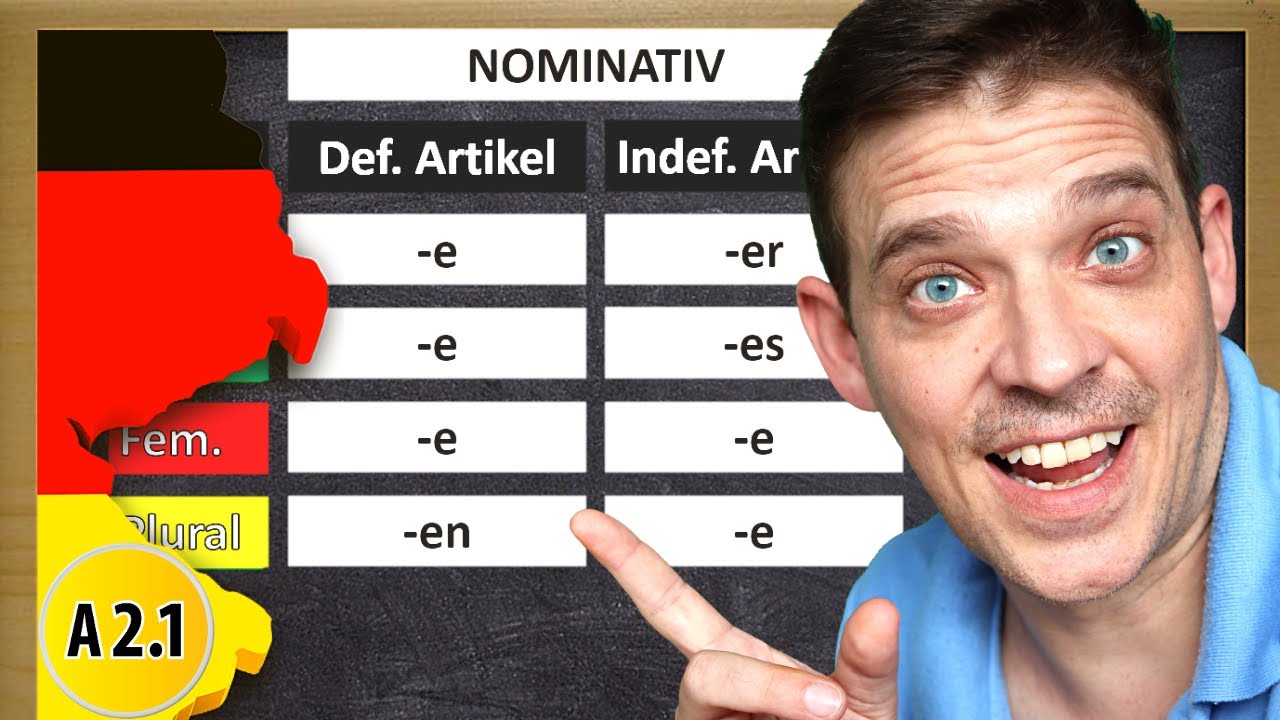
German adjective endings look chaotic until you see the system behind them. This lesson explains why adjectives get endings, when you need them and how the nominative endings work, including a long bonus tip on the whole concept.
When Do You Have to Decline an Adjective?
You decline an adjective w...
Masculine and neuter nouns get an ending in the genitive, but is it -s or -es? This short but packed lesson explains how to choose the correct genitive ending. The video itself is explained entirely in German.
Which Nouns Get an Ending?
Only masculine and neuter nouns take an ending in the genitiv...
There are only 12 verbs at A2 level that require the dative, and once you know them, you know when the dative is needed. This lesson goes through all of them with the meaning and an example sentence for each one, plus a bonus tip on passen versus stehen.
Why Dative Verbs Are Worth Learning
Across ...

The genitive is usually the last case you learn, and it is easier than its reputation. This lesson covers the genitive articles, the rules that come with them, and example sentences for all genders. The video itself is explained entirely in German.
Where You Will Meet the Genitive
The genitive is ...
Only about 60 German verbs require the dative case from A1 to C1, and just 14 of them belong to A1. Knowing them gives you a big advantage when you build correct German sentences. Below you find all 14 with their meaning and an example, plus a bonus tip on impersonal expressions such as Mir ist ka...

In the dative, the relative pronoun looks a little different from the article, and that is the one thing to memorise. This lesson explains the Relativsatz im Dativ and the Relativpronomen im Dativ. Note that the video itself is explained entirely in German.
When Do You Need the Dative?
The pronoun...
Where are you going? German needs one of five little words to answer, and choosing the right one trips up a lot of learners. This lesson covers all five Richtungspräpositionen (prepositions of direction): nach, zu, in, auf and an, with rules and tendencies you can rely on.
The Five Prepositions of...
These 30 German verbs all require the accusative, and because they are also very common and important, learning them improves your speaking right away. Every verb comes with its meaning and an example sentence, and there is a bonus tip on the few verbs that take two accusative objects.
What Are Ak...
In the accusative, only one relative pronoun changes: der becomes den. This second lesson of our Relativsatz series shows how to build a relative clause in the accusative and why that case is needed.
Why the Accusative?
The case of a relative pronoun depends on its role inside the relative clause....
A relative clause lets you add information to a noun without starting a new sentence. This is the first lesson in our Relativsatz series and it covers what makes a German relative clause tick, plus the relative pronouns in the nominative case.
What Is a Relative Clause?
A relative clause (Relativs...