
Text Analysis | German A1 Prepositions 🎯
At A1 level you need 20 German prepositions: five take the accusative and fifteen take the dative. This lesson is a text analysis. We read a short text about Lars and Maria on vacation in Italy and look at every preposition: which case it takes and how you can see it. The bonus tip at the end looks ahead to A2, where nine of the dative prepositions become two-way prepositions.
The 20 Prepositions at A1 Level
| Group | Prepositions |
|---|---|
| Accusative (5) | bis, für, um, gegen, ohne |
| Dative (15) | aus, bei, mit, nach, von, ab, in, an, auf, vor, hinter, neben, über, unter, zwischen |
The most important rule: the article and the noun that follow a preposition take the case of the preposition.
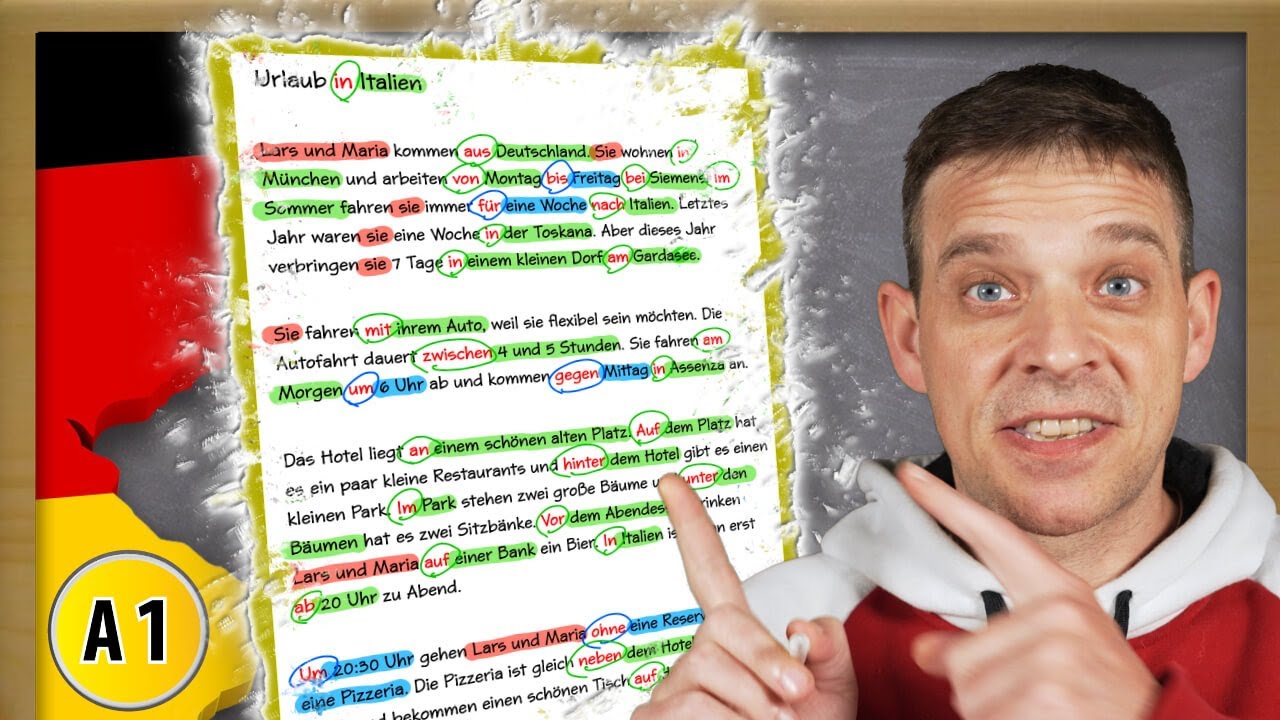
The Text: Urlaub in Italien
Lars und Maria kommen aus Deutschland. Sie wohnen in München und arbeiten von Montag bis Freitag bei Siemens. Im Sommer fahren sie immer für eine Woche nach Italien. Letztes Jahr waren sie eine Woche in der Toskana. Aber dieses Jahr verbringen sie sieben Tage in einem kleinen Dorf am Gardasee.
Sie fahren mit ihrem Auto, weil sie flexibel sein möchten. Die Autofahrt dauert zwischen 4 und 5 Stunden. Sie fahren am Morgen um 6 Uhr ab und kommen gegen Mittag in Assenza an.
Das Hotel liegt an einem schönen alten Platz. Auf dem Platz hat es ein paar kleine Restaurants und hinter dem Hotel gibt es einen kleinen Park. Im Park stehen zwei große Bäume und unter den Bäumen hat es zwei Sitzbänke. Vor dem Abendessen trinken Lars und Maria auf einer Bank ein Bier. In Italien isst man erst ab 20 Uhr zu Abend.
Um 20.30 Uhr gehen Lars und Maria ohne eine Reservierung in eine Pizzeria. Die Pizzeria ist gleich neben dem Hotel. Sie haben Glück und bekommen einen schönen Tisch auf der Terrasse über dem Wasser.
Paragraph 1: Where They Live and Travel
| Phrase | Case | Note |
|---|---|---|
| in Italien, aus Deutschland, in München | dative | Most countries and all cities have no article, so you cannot see the case. With an article you can: Urlaub in der Schweiz, im Iran. |
| von Montag bis Freitag | dative / accusative | von takes the dative, bis the accusative. They are used with weekdays or times: von 18 Uhr bis 20 Uhr. |
| bei Siemens | dative | bei + company name |
| im Sommer | dative | im = in + dem, der Sommer |
| für eine Woche | accusative | für is an accusative preposition. |
| nach Italien | dative | nach always takes the dative. |
| in der Toskana | dative | die Toskana is feminine, so der. |
| in einem kleinen Dorf | dative | das Dorf, so einem. |
| am Gardasee | dative | am = an + dem, der See |
Sentence structure: Im Sommer fahren sie ... starts with a preposition and a noun instead of the subject. This is very common and sounds more like real-life German.
The preposition an: as a local preposition, an is used when something is right next to something else, almost touching it. The village is right at the lake: am Gardasee.
Verbringen means to spend time: Zeit verbringen, Urlaub verbringen.
Paragraph 2: The Journey
| Phrase | Case | Note |
|---|---|---|
| mit ihrem Auto | dative | das Auto, so ihrem. |
| zwischen 4 und 5 Stunden | dative | time, no article |
| am Morgen | dative | As a time preposition, an is used with weekdays and times of day: am Morgen, am Abend, am Montag. |
| um 6 Uhr | accusative | um + time. No article, so you cannot see the case. |
| gegen Mittag | accusative | gegen means "around" or "shortly before" here. It is not very common at A1. |
| in Assenza | dative | name of the village, no article |
Abfahren means to leave or depart and ankommen to arrive. Die Autofahrt is the car journey and dauern means to last.
Paragraph 3: The Hotel and the Park
| Phrase | Case | Note |
|---|---|---|
| an einem schönen alten Platz | dative | der Platz (square). The hotel is right at the square. |
| auf dem Platz | dative | der Platz |
| hinter dem Hotel | dative | das Hotel |
| im Park | dative | in + dem, der Park |
| unter den Bäumen | dative plural | ein Baum, zwei Bäume. In the dative plural the noun gets an extra -n: den Bäumen. |
| vor dem Abendessen | dative | das Abendessen |
| auf einer Bank | dative | die Bank is feminine, so einer. |
| ab 20 Uhr | dative | time, no article |
Zu Abend essen (to have dinner) and zu Mittag essen (to have lunch) are fixed terms. Erst emphasises that 8 p.m. is late. Ein Bier has no preposition. It is the accusative object.
Paragraph 4: The Pizzeria
| Phrase | Case | Note |
|---|---|---|
| um 20.30 Uhr | accusative | um + time |
| ohne eine Reservierung | accusative | ohne means without. |
| in eine Pizzeria | accusative | Here in takes the accusative. The bonus tip explains why. |
| neben dem Hotel | dative | gleich neben means right next to. |
| auf der Terrasse | dative | die Terrasse |
| über dem Wasser | dative | das Wasser |
Glück haben means to be lucky.
The adjective endings in einem kleinen Dorf or einem schönen alten Platz are called Adjektivdeklination. That is an A2 topic, so you do not need to worry about it at A1.
Bonus Tip: Wechselpräpositionen (A2)
Nine of the dative prepositions are in fact two-way prepositions (Wechselpräpositionen): in, an, auf, vor, hinter, neben, über, unter, zwischen. From A2 on they can take the dative or the accusative.
| No movement: dative | Movement from A to B: accusative |
|---|---|
| Ich wohne in der Stadt. I live in the city. | Ich fahre in die Stadt. I am going into town. |
| Die Zeitung liegt auf dem Tisch. The newspaper is lying on the table. | Ich lege die Zeitung auf den Tisch. I put the newspaper on the table. |
With verbs like sein, wohnen or liegen there is no movement, so you use the dative. With verbs like fahren, gehen, fliegen or kommen there is a movement, so you use the accusative. That is why it is in eine Pizzeria gehen.
What to Learn Next
The full list with example sentences is in All German A1 Level Prepositions. The two-way rule is explained in detail in German Two-Way Prepositions: Dative or Accusative. When you are ready for A2, continue with All German A2 Prepositions: Explained in Context. For erst and schon, see When to Use erst and schon in German.
Frequently Asked Questions
How many prepositions are there at German A1 level?
20. Five take the accusative (bis, für, um, gegen, ohne) and fifteen take the dative.
Which A1 prepositions take the accusative?
Bis, für, um, gegen and ohne.
How can I see the case after a German preposition?
Look at the article: in der Toskana, mit ihrem Auto, für eine Woche. With names of cities, most countries and times there is no article, so you cannot see it.
What does am mean in German?
Am is an + dem. It is used for places right next to something (am Gardasee) and for weekdays and times of day (am Morgen, am Montag).
Why is it in eine Pizzeria but in der Toskana?
In is a two-way preposition. With a movement from A to B (gehen) it takes the accusative: in eine Pizzeria. Without movement (sein) it takes the dative: in der Toskana.
Prepositions are easiest to learn in real sentences. Our A1 German online course takes you through them step by step, with texts and exercises.
