Ich spiele Fußball am Samstag. Sounds fine, right? Not in German — it's one of the most common Satzbau (sentence structure) mistakes A1 and A2 learners make. 😅 In this lesson, we go through 20 of the most common German word order mistakes, from where the verb goes to where "nicht" belongs, with th...
Ich kann Deutsch sprechen, aber ich muss noch viel lernen, und ich will besser werden. In this complete guide you learn all six German modal verbs: können, müssen, wollen, dürfen, mögen and sollen. You get the present and Präteritum tables, the sentence structure, the meaning of each verb and the ...
German has two completely normal ways to talk about the future, and beginners often only learn one of them. In this lesson we cover both: using the present tense with a time expression (the way Germans usually speak), and Futur I — the "werden + infinitive" construction that textbooks focus on. By...
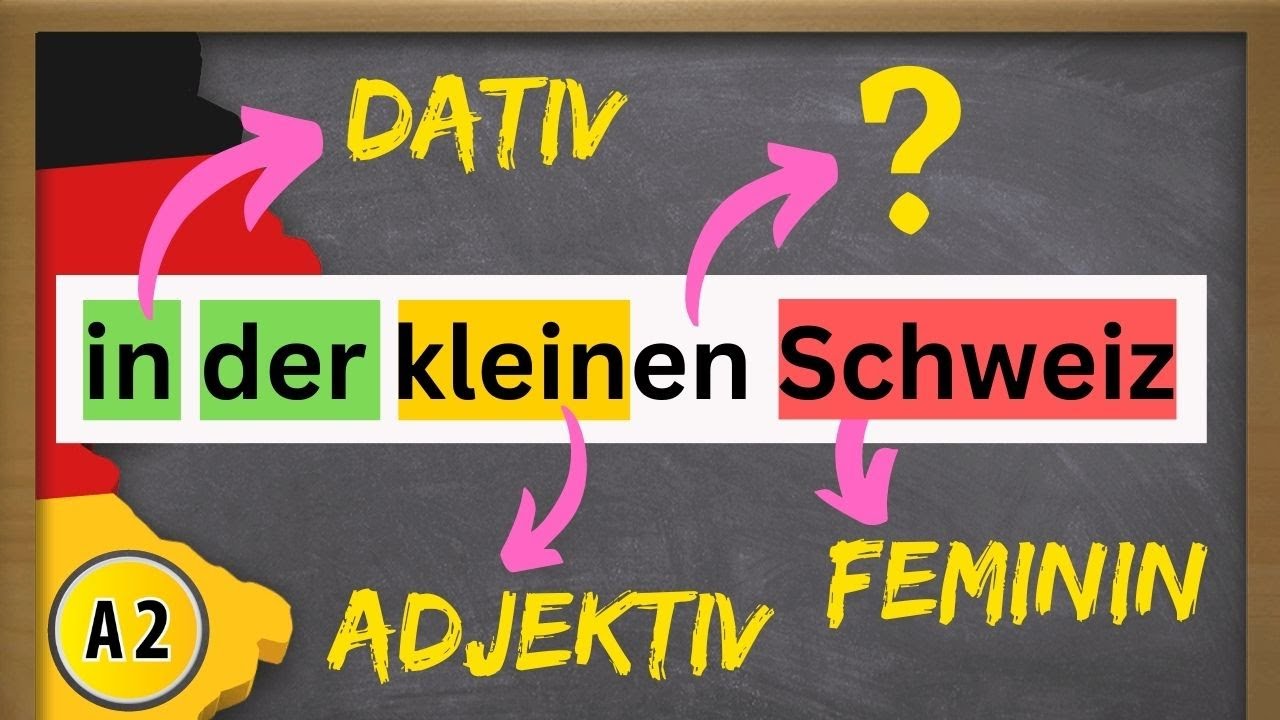
The best way to learn adjective endings is to take a real text apart and explain every single ending. In this lesson Luzi analyzes a short text called “Antonios Reise in die Schweiz” and shows, adjective by adjective, which case it is in, which article comes before it and why the ending is what it...
A reflexive verb always comes with a reflexive pronoun that refers back to the subject. It is a complicated topic, so Johannes keeps it as simple as possible and teaches you only what you need for A2: the pronouns, their position in the sentence and eight important verbs with example sentences.
Wh...
English only has one word for "who" (and a slightly old-fashioned "whom"), but German has three: wer, wen, and wem. The good news is they're not random — each one simply asks about a different grammatical case. Once you know the case system, these three little words stop being confusing and become...
Zu and bei are two of the most frequent prepositions in everyday German, and both can be translated as "to" or "at" in English — which is exactly why they get mixed up. In this lesson we break down when each one is used, work through plenty of example sentences, and finish with the classic beginne...
The simple past (Präteritum) of modal verbs is one of the most useful things you can learn at A2 level, because Germans use Präteritum for modal verbs even in spoken conversation — unlike most other verbs, which usually take Perfekt in speech. In this lesson you'll learn how to build the Präteritu...
In a German subordinate clause (Nebensatz) the conjugated verb always goes to the end, and if the sentence starts with that clause, the verb of the main clause comes right after the comma. This is one of the most common mistakes German learners make. Luzi shows you the rule with four situations (p...
The position of "nicht" trips up German learners at every level, because the rule isn't "nicht always goes here" — it depends on what exactly you're negating. In this lesson we go through the core rule, the important exception around verbs, and several real examples so you can place "nicht" correc...