In a German subordinate clause (Nebensatz) the conjugated verb always goes to the end, and if the sentence starts with that clause, the verb of the main clause comes right after the comma. This is one of the most common mistakes German learners make. Luzi shows you the rule with four situations (p...
The fastest way to learn dürfen and müssen is to use them in complete sentences: 14 of them in this exercise. This is a practice video in German only, at A1 level. First you see the conjugation of both modal verbs, then you complete 14 sentences with dürfen or müssen in the right form and the verb...
The position of "nicht" trips up German learners at every level, because the rule isn't "nicht always goes here" — it depends on what exactly you're negating. In this lesson we go through the core rule, the important exception around verbs, and several real examples so you can place "nicht" correc...

Können is one of the first modal verbs every German learner meets — but most learners only ever learn one of its three real meanings. This lesson covers all three, the conjugation, the sentence structure rule that goes with it, and a bonus tip about using können without a second verb at all.
What ...
A1 German already has 40 irregular verbs, out of only around 200 in the whole language, because many of the most basic verbs are irregular. Luzi gives you all of them in alphabetical order, each with its present tense conjugation, its Partizip and an example sentence. He suggests that you write yo...

"Deshalb" is one of the most useful connecting words in German: it lets you link a reason to its consequence — "he overslept, that's why he was late" — in a single, natural-sounding structure. The good news is that once you know the sentence pattern, "deshalb" is genuinely easy to use correctly. T...
In the Goethe A1 speaking exam you are not alone: there are two examiners and up to four participants, and you talk to each other. Johannes explains the three parts of SPRECHEN in Goethe-Zertifikat Start Deutsch A1 with real examples: introducing yourself, asking and answering questions, and makin...
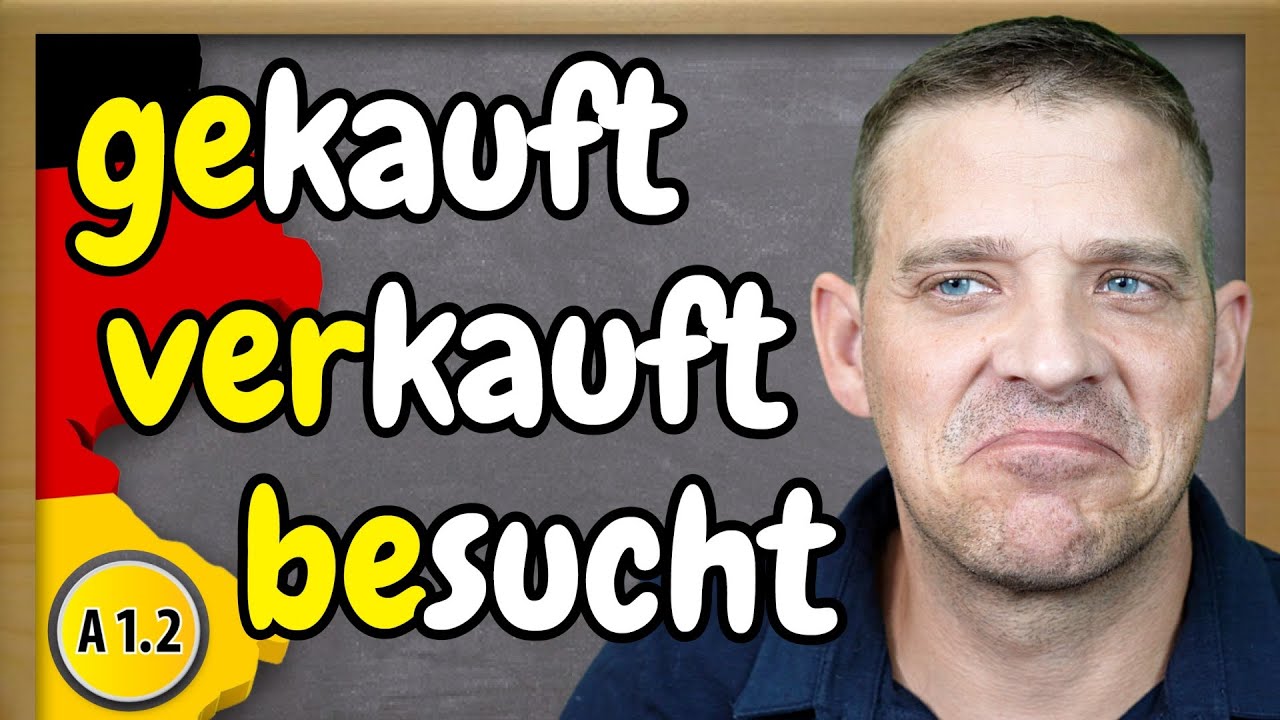
Most German past participles start with ge- — but a large and completely predictable group of verbs never gets a ge- at all. The good news: it's not random. Two clear rules tell you exactly when to leave it off.
The Regular Pattern (For Comparison)
Normally, a past participle is built as ge- + ste...

Is It Der, Die, or Das? Here's How to Actually Know
German nouns come in three genders — masculine (der), feminine (die), and neuter (das) — and every noun needs the right one. The good news: gender in German isn't random. Once you know the patterns, you can guess correctly most of the time, even ...
Can you understand a short German conversation about names, family and hobbies? This is a listening exercise for A1 learners. Two short role-play dialogues, each followed by seven questions, train you to catch the key information: who someone is, where they come from, where they live, what they do...